What Is an ISRC Code? How to Get One (and Find Yours) in 2026
An ISRC identifies one recording, not one song. How to read it, get it free from your distributor or national agency, find it on Spotify, and ISRC vs UPC.
On this page
An ISRC (International Standard Recording Code) is a 12-character code that identifies one specific recording, not the song itself. A studio version, a live version and a radio edit of the same song each get their own ISRC. Streaming services and collecting societies use it to track plays and pay the right recording.
The code stays with the recording for good, whatever format it appears on and whoever owns it (US ISRC Agency; ISRC Handbook, 4th edition, section 4.6). The song as a composition is identified separately by an ISWC, which your publisher or performing rights organization handles (ISO 15707).
How to read an ISRC
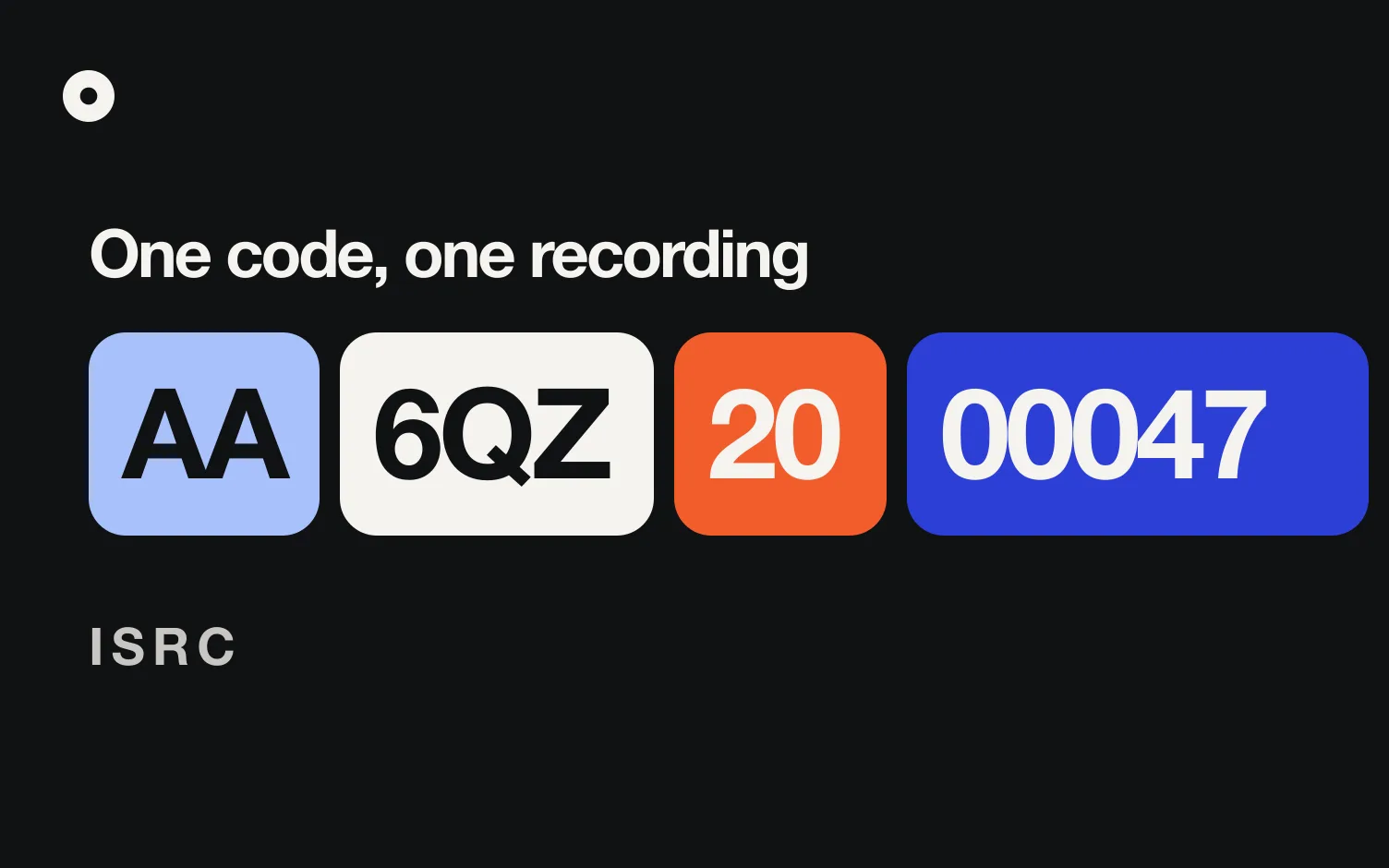
An ISRC has three parts, 12 characters in total (IFPI, ISRC structure). Checked October 21, 2026.
| Part | Length | Example | Meaning |
|---|---|---|---|
| Prefix code | 5 (2 letters + 3 letters or digits) | AA6QZ | Allocated by an ISRC agency to a registrant |
| Year of reference | 2 digits | 20 | Last two digits of the year the code was assigned |
| Designation code | 5 digits | 00047 | Picked by the registrant, never repeated within a year |
IFPI's own example is ISRC AA-6QZ-20-00047. The "ISRC" label and the hyphens are only for display; the code itself is AA6QZ2000047.
Two details people often get wrong:
- The first two letters are not the artist's country. They are the code of the agency that allocated the prefix, and IFPI now describes the prefix as one five-character code; the split into two letters plus three is kept for compatibility with older versions of the standard (IFPI). The Handbook adds that no meaning should be read into any one element, and that the prefix can't be assumed to identify the current rights owner (section 3.3.1).
- The year is when the code was assigned, not when the track was recorded (Handbook, section 3.3.3).
Paste one of yours below to see its parts and the agency behind its prefix. It's read in your browser; nothing is sent.
Decode an ISRC
Paste a code with or without the label, hyphens or spaces. Nothing is sent anywhere.
Which agency is behind the first two letters
From IFPI's list of agency code allocations, dated October 2026 (PDF). The United States has several codes, which is why an American release can start with QZ or QM instead of US:
| First two letters | Agency | Territory |
|---|---|---|
| US, QZ, QM, QT | RIAA | United States |
| GB, UK | PPL | United Kingdom |
| CA | Re:Sound | Canada |
| MX | AMPROFON | Mexico |
| BR | Pro-Música Brasil | Brazil |
| AR | CAPIF | Argentina |
| ES | AGEDI | Spain |
| CO | International ISRC Registration Authority | Colombia |
| ZZ | International ISRC Registration Authority | Worldwide |
How to get ISRC codes
There are two routes.
1. Through your distributor (automatic, usually free). Most distributors assign an ISRC to each track when you upload. DistroKid, for example, says it "has been appointed by the US ISRC Agency to assign ISRCs" and that its codes are "free and automatic" (DistroKid Help). IFPI calls this role an "ISRC Manager", and says they are often digital aggregators or distributors (Handbook, Annex D). The prefix then belongs to the distributor, not to you. If you haven't picked one yet, see how to release music on Spotify.
2. As your own registrant, through your national agency. You apply for your own prefix and assign codes yourself. You don't need to be an IFPI member or join any trade body (IFPI FAQ). It is not always free: in the United States there is a one-time US$95 administrative fee for a prefix, with no further cost after that (US ISRC Agency, checked October 21, 2026). Fees elsewhere vary; find your agency in IFPI's agency contacts (RIAA in the United States, PPL in the UK, AMPROFON in Mexico, ACINPRO in Colombia, Pro-Música in Brazil, AGEDI in Spain).
Your own prefix makes sense if you release often, work with several distributors, or want every code to point to you. If you release a few singles a year through one distributor, the distributor's code is usually enough.
Who assigns the ISRC, by distributor
Checked October 21, 2026.
| Distributor | Assigns one on its own? | Can you use your own? | Source |
|---|---|---|---|
| DistroKid | Yes, free, just before delivery to stores; not available before upload | Yes, on the Musician Plus and Ultimate plans | DistroKid Help |
| TuneCore | Yes, generated when you save the song's details | Yes, in the "ISRC Number" field | TuneCore Help |
| CD Baby | Yes, at the inspection stage; you can ask for them earlier once the track list is final and the release is paid | Yes | CD Baby Help |
| Amuse | Yes, free, if you leave the field blank; shown after approval | Yes, and required if the track was already released | Amuse Support |
| Ditto | Yes, free | Yes, at stage 2 of the Release Builder, per track | Ditto Help |
ISRC vs UPC
| ISRC | UPC | |
|---|---|---|
| Identifies | One recording (a track) | One product (a single, EP or album) |
| Format | 12 letters and digits | 12 digits (a GTIN-12, per GS1) |
| Issued by | ISRC agencies or their ISRC Managers (IFPI) | GS1, or your distributor (TuneCore) |
| On a 5-track EP | 5 ISRCs | 1 UPC |
| Same track on a later album | Keeps the same ISRC | The album gets a new UPC |
The Handbook says a recording reused on a compilation without change keeps its ISRC, and that telling releases apart is the job of product identifiers like the UPC (section A.8.4). Whether that product is a single, an EP or an album depends on its track count and length: see EP vs album vs single.
How to find the ISRC of a song already on Spotify
The Spotify app does not show ISRCs. Three ways to find one:
- Your distributor's dashboard. On DistroKid, open the release from your dashboard; the ISRC is listed across from each track (DistroKid Help). TuneCore shows it under each track on the release overview (TuneCore Help). CD Baby lists it under Tracks & Audio (CD Baby Help).
- The Spotify Web API. The track object includes
external_ids.isrc(Spotify for Developers, Get Track, checked October 21, 2026). It takes a developer account, so it's the route for people who code. - Your previous distributor. Amuse and Ditto both say that for tracks released elsewhere you have to ask that distributor (Amuse Support; Ditto Help).
Common mistakes
- Reusing an ISRC on a different recording. A live version, a different take, a remix and a clean edit each need a new ISRC (Handbook, section A.9).
- Assuming every remaster needs a new ISRC. It depends. A new ISRC is assigned only if the remaster applies creative input. A level change, EQ or compression applied to the whole track, de-noising and a sample-rate change don't count (section A.10.1).
- Getting new ISRCs when you switch distributors. When you re-upload a track that is already out, use its existing ISRC (Amuse Support). Ditto says that's what keeps your stream counts and playlist placements with the track (Ditto Help). The ISRC doesn't change when a recording is sold or licensed unchanged (section 4.6). Copy your codes before closing an old account. Our music distributor comparison has the steps for leaving without losing streams.
- Giving the album version a new code when nothing changed. Same recording, same code; a different mix, a new code.
Where does Loud fit?
Loud doesn't touch ISRCs: your distributor assigns them and stores see them. We make Loud, which builds your website and link in bio from your music and makes a page for every release, with the listen buttons and a sign-up for your fan list. Once your tracks have their codes and a release date, that page is the next thing to set up: see what a release page needs and how Spotify pre-saves work. For when each step happens, see the music release checklist.
FAQ
Is an ISRC free?
From most distributors, yes. Your own prefix from the US ISRC Agency costs a one-time US$95 (usisrc.org).
Do I need an ISRC to release on Spotify?
In practice, yes: IFPI says many online services require an ISRC to identify a recording (Handbook, section 3.2), and your distributor assigns one if you don't have one, as DistroKid, TuneCore, CD Baby, Amuse and Ditto do.
Can I get an ISRC from DistroKid before uploading?
No. DistroKid assigns ISRCs just before delivering a release to stores. On the Musician Plus and Ultimate plans you can upload with a future release date, note the codes once they're assigned, and delete the release before that date if you don't want it to go live (DistroKid Help).
Is an ISRC the same as copyright registration?
No. Assigning an ISRC does not register copyright; that is a separate process (Handbook, section 4.5).
What is the difference between ISRC and ISWC?
ISRC identifies a recording; ISWC identifies the composition (ISO 15707).