Tech Rider and Stage Plot for Bands: Template and Example (2026)
What a tech rider and a stage plot are, what goes in each, how many channels your lineup needs, and a template with a full input list to copy.
On this page
A tech rider is the page that tells a venue's sound engineer what your show needs: who is on stage, every channel the sound desk has to patch (the input list), the monitors, the gear you bring and the gear you need from them, and how long you take to set up. The stage plot is the drawing that goes with it: where each person and instrument stands. Together they fit on one or two pages, and they're the part of your press kit a venue reads after it says yes.
Below: what goes in each, how many channels a typical lineup needs, a template you can copy, and a full example for a four-piece band.
What is a tech rider?
It's the technical half of the agreement between you and the venue. The booker reads your press kit to decide whether to book you; the sound engineer reads your tech rider to decide how to set up the stage. When it's clear, soundcheck is short and the show sounds the way you rehearsed it. When it's missing, the engineer guesses.
A tech rider usually has five parts:
- Contact. The person who answers technical questions, with a phone number, and your sound engineer if you travel with one.
- Lineup. Who plays what, in one line each.
- Input list. Every channel, numbered, with the microphone or direct box (DI) it needs.
- Monitors. How many mixes, wedges or in-ear, and who shares which.
- Backline and timing. What you bring, what you need the venue to provide, and how long you need to set up and soundcheck.
The hospitality rider (dressing room, water, meals) is a separate page. Keep it short when you're starting out, and only ask for what you really need.
What is a stage plot?
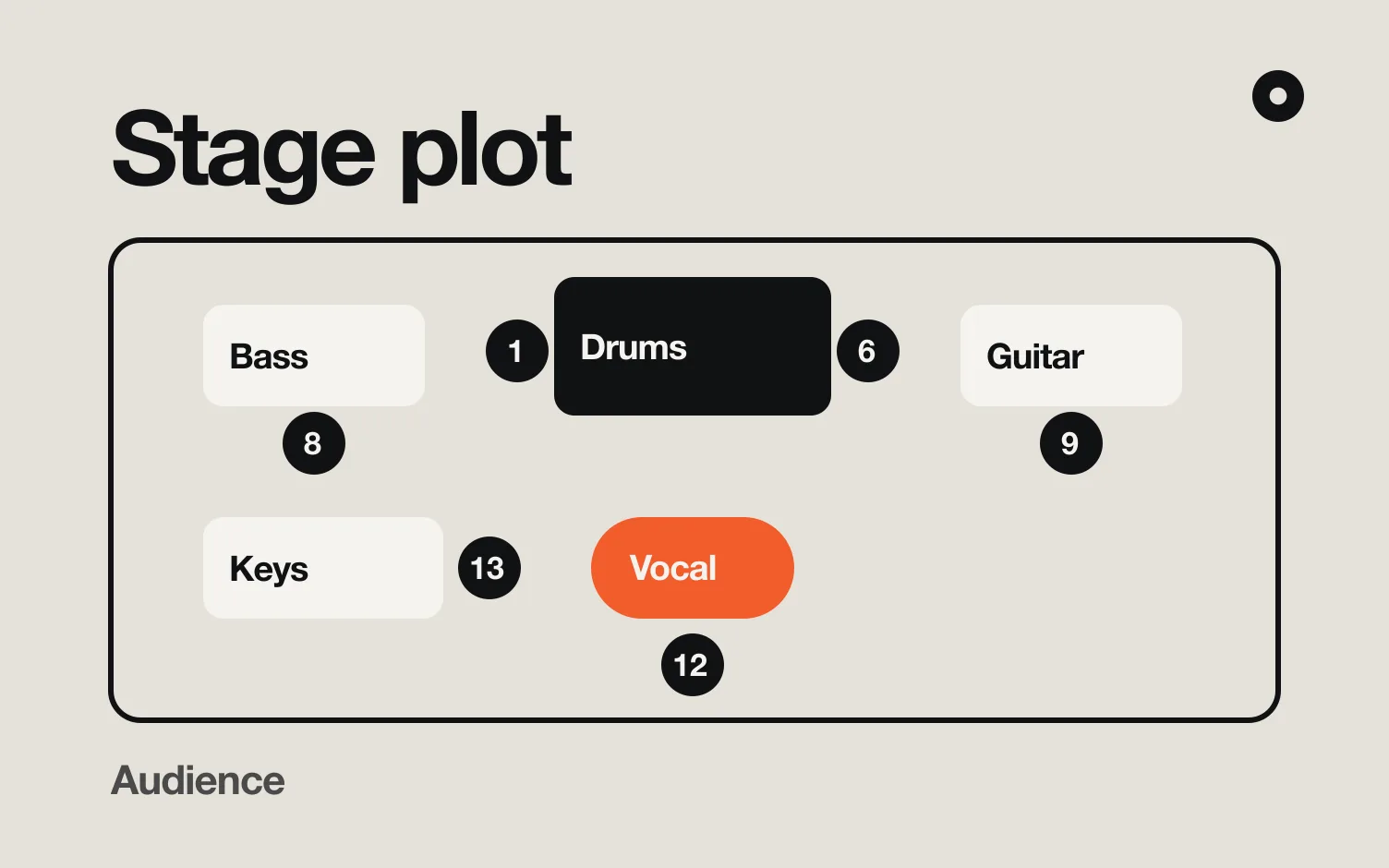
A simple drawing of the stage seen from above, with the front of the stage, where the audience is, at the bottom of the page. It shows where each member stands, each amplifier, the drum riser if there is one, every microphone stand, the monitors and where you need power.
Write "Audience" at the bottom so nobody reads it upside down. Stage left and stage right are the performer's left and right while facing the audience, which is the opposite of what the audience sees; labeling the front of the stage avoids that argument at soundcheck. Number each microphone on the drawing with the same number it has in the input list, so the engineer can match the two pages at a glance.
You don't need special software. A clean drawing with boxes and labels is enough, and the free maker below does it for you, with an input list that uses the same numbers.
Stage plot maker
Set your lineup, then drag everyone to their place. The numbers on the drawing match the input list.
Who's on stage
tech rider
Monitor mixes: 3
Stage plot
Seen from above. Drag to move, or select one and use the arrow keys.
Input list: 13 channels
Change any microphone to what you really use.
- 1KickShort stand
- 2SnareShort stand
- 3Hi-hatShort stand · Can go if channels are short
- 4Rack tomClip
- 5Floor tomClip
- 6Overhead LTall stand
- 7Overhead RTall stand · Can go: one overhead is fine
- 8BassAmp on stage, DI before the amp
- 9Guitar ampShort stand
- 10Keys LStereo
- 11Keys RStereo
- 12Lead vocalTall stand, round base · Center
- 13Backing vocalTall boom stand
We start from the lead vocal alone and the rest in pairs. Change it if you need more.
The rest of your rider
How many channels does my band need?
A rough starting point by lineup, before you count your own setup:
| Lineup | Channels, about | What fills them |
|---|---|---|
| Solo, voice and acoustic guitar | 2 to 3 | Vocal, guitar DI, sometimes a second mic on the guitar |
| DJ | 2 to 4 | The mixer's stereo output, plus a mic for talking |
| Duo with backing tracks | 4 to 6 | Two vocals, one instrument, tracks in stereo |
| Four-piece rock or pop band | 12 to 16 | Drums take half, then bass, guitar, keys and vocals |
| Band with tracks and keys | 16 to 20 | The above, plus stereo keys and stereo tracks |
Small venues often have a 16 or 24 channel desk. If your list is longer than what the venue has, cut drum microphones first (one overhead instead of two, no separate hi-hat) and say in your rider which channels can go.
Tech rider template
Copy this and fill in the brackets. Delete what doesn't apply.
[Artist name]: tech rider, updated [month year]
Technical contact: [name], [phone], [email]
Lineup: [name], vocals and guitar · [name], bass · [name], drums · [name], keys and backing vocals
Input list: see table
Monitors: [number] mixes. [Who shares a mix, wedges or in-ear.]
We bring: [instruments, amps, pedals, in-ear packs, laptop]
We need from the venue: [drum kit, bass amp, DI boxes, stands, power at the front of the stage]
Set up and soundcheck: [minutes] to set up, [minutes] to soundcheck. Set length: [minutes].
Stage plot: attached, with the same channel numbers.
Example: a four-piece band's input list
A fictional band with drums, bass, guitar, keys, a lead vocal and one backing vocal. Microphones are what's common, written "or similar" so the venue can use what it has.
| Ch | Input | Mic or DI | Stand | Notes |
|---|---|---|---|---|
| 1 | Kick | Kick drum mic or similar | Short | |
| 2 | Snare | SM57 or similar | Short | |
| 3 | Hi-hat | Small condenser | Short | Can go if channels are short |
| 4 | Rack tom | Dynamic or clip-on | Clip | |
| 5 | Floor tom | Dynamic or clip-on | Clip | |
| 6 | Overhead L | Condenser | Tall | |
| 7 | Overhead R | Condenser | Tall | Can go: one overhead is fine |
| 8 | Bass | DI | Bass amp on stage, DI before the amp | |
| 9 | Guitar amp | SM57 or similar | Short | |
| 10 | Keys L | DI | Stereo | |
| 11 | Keys R | DI | Stereo | |
| 12 | Lead vocal | SM58 or similar | Tall, round base | Center |
| 13 | Backing vocal | SM58 or similar | Tall boom | Stage left, keys |
Monitors for the same band: three mixes. The lead vocal alone, guitar and bass sharing one, drums and keys sharing one.
On the stage plot, the drums go center back, bass to the drummer's left, guitar to the right, keys at the front of stage left, the lead vocal at the front center, and power at each amp and at the keys.
Tips that save your soundcheck
- Send it with the confirmation, not the day of the show. Ask the venue for its own tech sheet in return, so you know what they have.
- Ask your sound engineer to check the input list if you have one. They'll catch what you forgot.
- Keep one version per lineup. A full band rider and a reduced one for small rooms or acoustic sets.
- Put the date on it and update it when your setup changes.
- Send it as a link or a PDF, never as photos of a notebook. Keep it next to your bios and press photos, where the venue already found your contact.
Where does Loud fit?
Loud doesn't make riders. It builds your website and link in bio from your music, keeps your shows and releases current, and puts your booking and management contact on the site, so the venue that got your tech rider can also hear what you sound like and see where you've played. If you don't have a site yet, see how to make a music website.
FAQ
What is a tech rider for a band?
A one or two page document for the venue's sound engineer: your lineup, every channel you need (the input list), monitors, the gear you bring and need, and how long you need to set up and soundcheck.
What is a stage plot?
A drawing of the stage from above, with the audience at the bottom of the page, showing where each member, instrument, microphone, monitor and power point goes.
What's the difference between a tech rider and a hospitality rider?
The tech rider covers sound and the stage. The hospitality rider covers the people: dressing room, water, food and guest list.
What is an input list?
The numbered list of every channel the sound desk has to patch, from the kick drum to the vocals, with the microphone or DI each one needs.
Do solo artists need a tech rider?
Yes, a short one. Even a voice and a guitar need two channels, a monitor and a stand, and telling the venue avoids surprises.
When should I send my tech rider?
When the show is confirmed, together with your stage plot, so the venue has time to check it against what it has.