How to Email a Venue to Book a Gig: Templates and Follow-Ups (2026)
How to write a booking email to a venue or promoter: who to write to, what to put in it, subject lines, three templates and when to follow up.
On this page
To book a gig by email, write to the person who books the venue, by name, in five or six lines: who you are and what you sound like, why you fit that room or night, the dates you want, how many people you can honestly bring, and one link with your music, a live video and your past shows. Put the artist, the city and the month in the subject line. If nobody answers, follow up once after about a week.
Below: who to write to, what a booker looks for, subject lines, three templates you can copy, and how to follow up without becoming the email they ignore.
Who do I email to book a show?
The person who decides the lineup. At a small venue it's often called the booker, the talent buyer or the programmer; at a bar it may be the owner. Look in this order:
- The venue's website, usually under Contact, Booking or Events.
- The venue's Instagram, in the bio or the highlights. Many small venues take booking requests there.
- A promoter who already runs nights there. Look at the posters: if the same name puts on the shows you'd fit, write to the promoter instead of the venue.
- Artists who played there. Ask them who booked them; it's the fastest way to the right inbox.
Write to one person by name. A message to "Hi team" in a general inbox competes with invoices and deliveries.
What should a booking email include?
A booker reads it in under a minute and asks four questions. Answer them in order:
| The booker asks | You answer with |
|---|---|
| Who is this and what do they sound like? | Name, genre, city, and one comparison or detail they'll remember |
| Do they fit my room? | The night, series or past lineup you'd fit, by name |
| When? | Specific dates or a two-week window |
| Will people come? | Your honest draw: "we brought 60 people to [venue] in September" |
Then one link, not five. A website or press kit with your music, a live video, the shows you've played and your booking contact answers anything else. No attachments: they get stuck in spam filters and nobody opens an MP3 from a stranger.
Subject lines
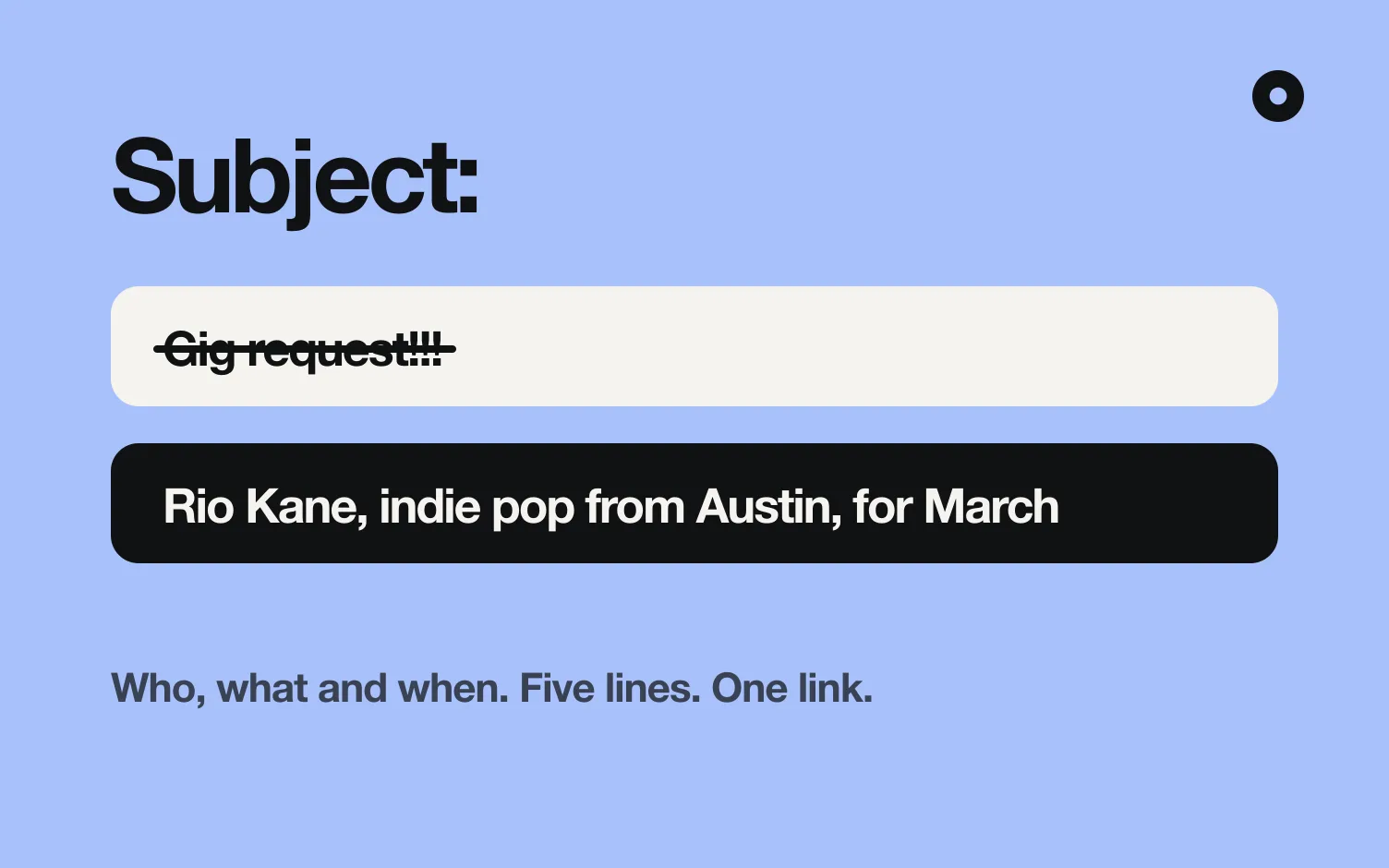
Say who, what and when, so the booker can sort it without opening it:
- [Artist], [genre] from [city], for [month]
- Booking: [Artist] for a [weekday] in [month]
- [Artist] to open for [headliner] at [venue] on [date]
- Local opener for your [series name] night
Avoid "Hello", "Gig request" or anything in all caps.
Booking email templates
First email to a small venue
Subject: [Artist], [genre] from [city], for [month]
Hi [name],
I'm [your name] from [Artist], a [genre] [band/artist] from [city]. We saw [act] play your [night/series] and think we'd fit it.
We're looking for a date between [date] and [date]. Last [month] we played [venue] in [city] and brought about [number] people.
Music, a live video and our past shows: [link]
Would you have an opening? Happy to send our tech rider or talk by phone.
Thanks, [your name], [Artist], [phone]
Asking to open for a show already booked
Subject: [Artist] to open for [headliner] on [date]
Hi [name],
I saw [headliner] is playing [venue] on [date]. We're [Artist], a [genre] act from [city], and our audience overlaps with theirs: [one honest reason, such as a shared playlist, a similar sound or the same scene].
If the opening slot is still open, we'd love it. We can play [minutes] and bring about [number] people.
Here's our music and a live video: [link]
Thanks, [your name], [Artist], [phone]
Following up
Subject: Re: [your original subject]
Hi [name],
Following up on the note below about [month]. We're still free on [dates]. If it's not a fit this time, I'd be glad to know who else to ask, or which dates work better.
Thanks, [your name]
When to follow up
Bookers are busy, and a lack of reply usually means "not yet", not "no". A common rhythm is one follow-up about a week after the first email, in the same thread, and a second one a week or two later. After that, move on and write again next season with something new: a release, a bigger show, a new video.
Mistakes that get booking emails ignored
- Writing to every venue in the city in one email. The booker can tell, and you can't name their night.
- No dates. "Sometime soon" makes the booker do your work.
- A long bio. Two sentences; the rest is in your link. Our guide on how to write an artist bio has a short version you can paste.
- Inflated numbers. Bookers compare notes. Say what you really drew, even if it's 30 people.
- A link that doesn't work on a phone, or one that sends them to five more links.
After they say yes
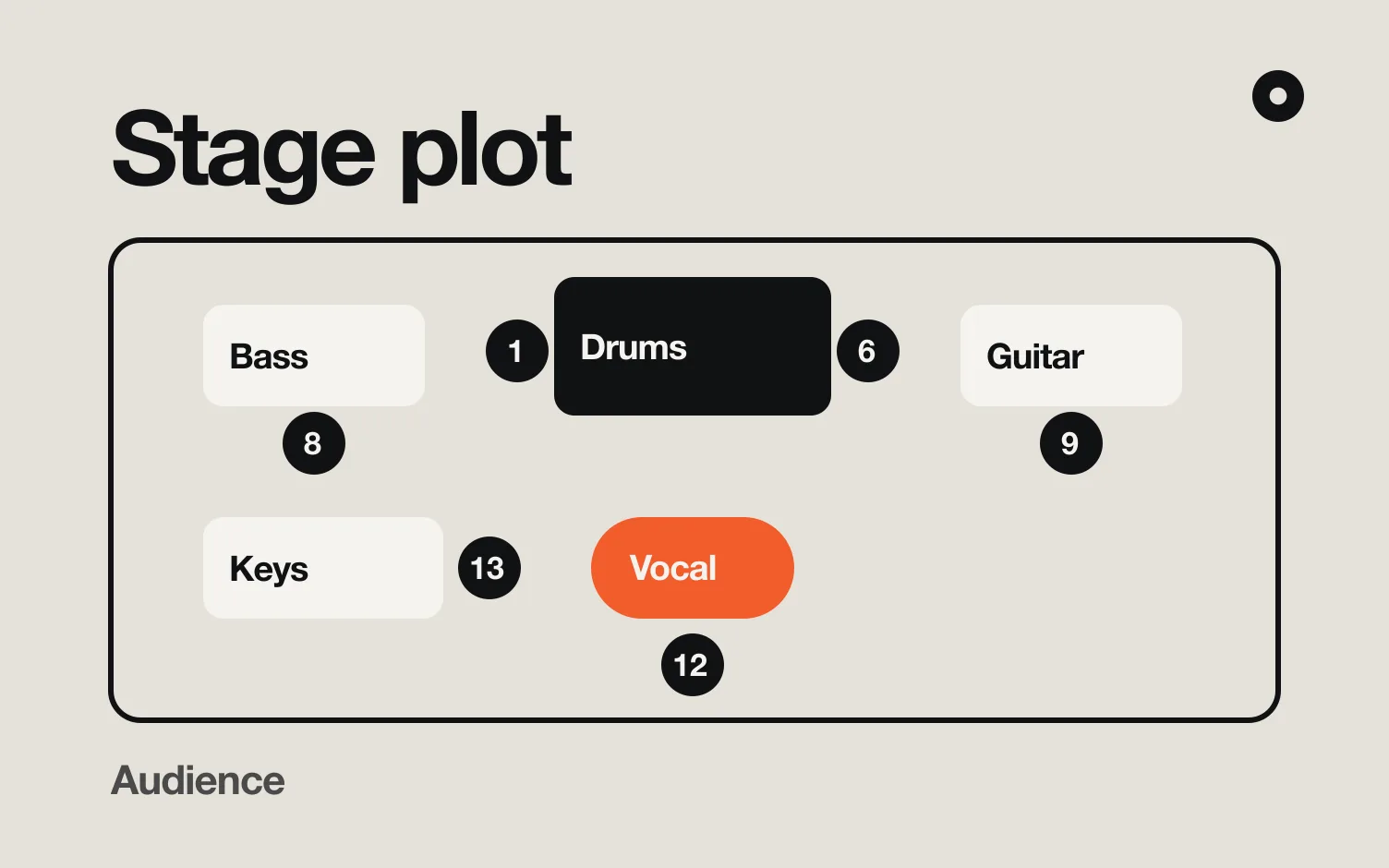
Confirm the date, the set time, the pay or door split, and what the venue provides, in writing, in the same thread. Then send your tech rider and stage plot so soundcheck is short, and start telling your fans: here's what to email your fans before a show.
Where does Loud fit?
Loud builds your website and link in bio from your music and keeps them current: releases, videos, the shows you've played and the ones coming up, and your booking contact on the site. That's the one link a booking email needs. It doesn't write or send booking emails for you. If you're starting, see how to make a music website.
FAQ
How do I ask a venue for a gig?
Email the person who books it, by name, with who you are, why you fit, the dates you want, your honest draw and one link with your music and a live video.
What do I write in the subject line of a booking email?
Your artist name, genre, city and the month you want, such as "Rio Kane, indie pop from Austin, for March".
How long should a booking email be?
Five or six lines. Everything else goes in the link.
How long should I wait before following up?
About a week. Follow up once in the same thread, again a week or two later, then move on.
Should I attach my music?
No. Send a link that plays on a phone. Attachments end up in spam and strangers' files rarely get opened.
What if I have never played a show?
Say so, and offer something small: an opening slot, a weeknight or an acoustic set. Lead with your music, a video of you playing and what makes your sound easy to remember.